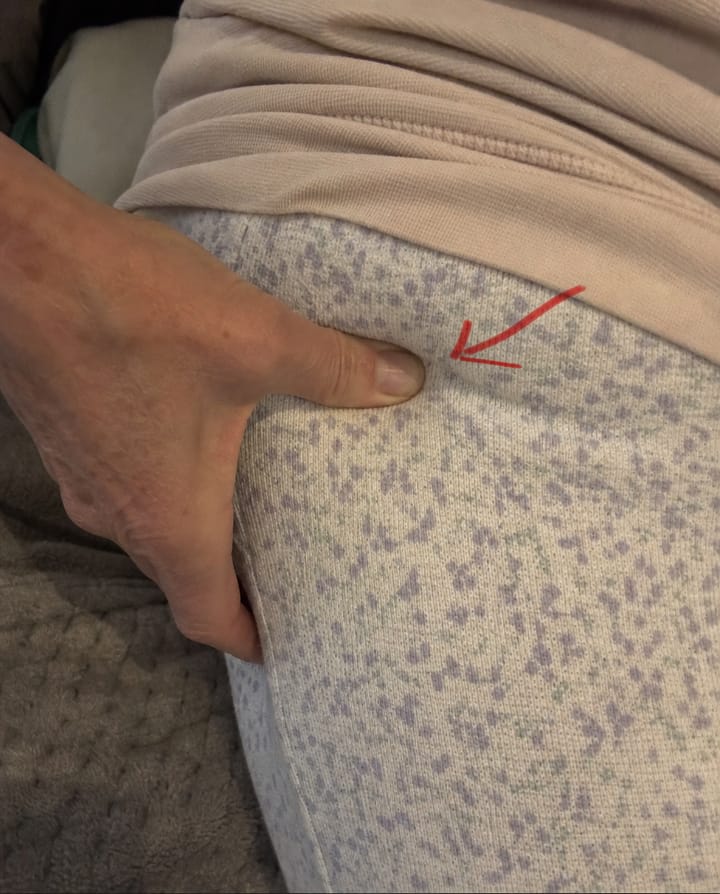

If your hip only screams when you lie on it, that one detail tells me more than an X-ray. I have spent fifteen years studying how women's tendons and joints age, and I want to walk you through why night pain is the clue almost everyone misses, doctors included. Think about what arthritis is. A worn joint. Worn joints complain when they work. Walking, climbing stairs, getting out of the car. A truly arthritic hip has no reason to hurt more in a soft bed than it did on your afternoon walk. And yet the story I hear from women over 50 is the opposite. The day is manageable. The night is the enemy. You lie down on your side, and within minutes there is a deep burn on the outside of your hip. You flip to the other side, it follows you there. You turn like a rotisserie chicken until you end up on your back staring at the ceiling, or standing in the kitchen at 3 AM. Here is what is actually happening. When you lie on your side, your body weight presses the gluteal tendons against the bony point of your hip. Healthy tendons handle that compression easily. Frayed tendons cannot. The pressure squeezes tissue that is already damaged, and it burns. Your bed is not the problem. The tendon is. Why is it frayed? Because after menopause, estrogen falls, and estrogen is the signal that keeps your body producing collagen, the material tendons are rebuilt from. Production drops by about 40 percent. Wear keeps happening every day, repair does not, and the tendons on the outside of your hip slowly come apart like old rope. Once you see that, you understand why nothing you bought for your nights has worked. The 2,000 dollar mattress. The wedge pillow between your knees. Sleeping in the recliner. Every one of those rearranges pressure. None of them rebuilds tendon. You cannot pillow your way out of tissue that has stopped repairing itself. The same goes for the medical routine. Pills mute the signal for half an hour. Cortisone quiets it for a few weeks while the tendon underneath grows weaker. Physical therapy loads a structure that has no materials to rebuild with, which is why it so often backfires. And I need to be direct about where this road goes, because night pain is not just miserable, it is a warning. Fraying that is never repaired continues. Research shows 73 percent of menopausal women with this pattern end up needing surgery within five years. On top of that, every bad night quietly taxes your blood pressure, your mood, your memory and your patience with the people you love. Sleep is not a luxury. It is when your body does its repair work, and this condition steals exactly that. There is a way to restart the repair. My team spent three years developing a light therapy system that reaches the tendon itself, about two inches deep, where ordinary red light devices stop at one. Three wavelengths work together. One opens circulation. One recharges the cell's energy engines, up to 150 percent more cell energy, which is what collagen building runs on. One calms deep inflammation and helps new collagen lay down strong and straight. Twenty minutes a day, sitting in your own chair. In our 90 day evaluation, 76 percent of women were back to sleeping on their side within 30 days, and 91 percent showed measurably thicker, denser tendon tissue on ultrasound by day 90. I explain the whole thing on one page. The science, the numbers, what it costs next to a single cortisone shot, and the 90 day guarantee. Try it for a full 90 days, and if your nights have not changed, every penny comes back to you. Picture one specific morning. You wake up, and the first thing you notice is that nothing woke you. You are on your side. You have been all night. That morning is a repaired tendon, nothing more mysterious than that. Read the page and see exactly how women are getting there.
Read more